

Contact with
us for any
soluton
Call Anytime
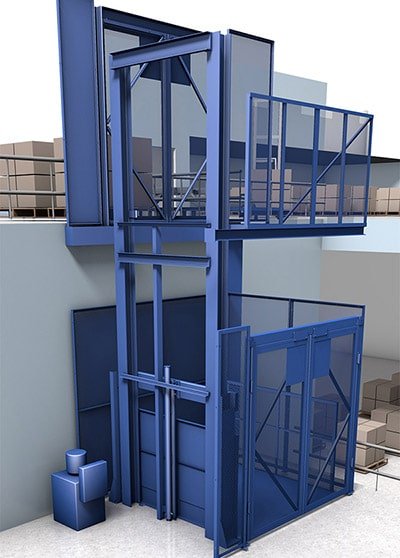
VRC Vertical Reciprocating Conveyor Lift for Efficient Vertical Material Handling
A Vertical Reciprocating Conveyor (VRC) is a high-performance lifting system designed to transport goods vertically between multiple floors, mezzanines, or storage levels in industrial and commercial facilities. Unlike traditional forklifts or manual lifts, VRCs automate the vertical movement of pallets, cartons, bins, or other materials, saving time, labor, and floor space.
Packveyor VRCs are engineered for safety, durability, and smooth operation, making them ideal for warehouses, distribution centers, manufacturing plants, automotive units, and logistics facilities where vertical material transfer is critical for workflow efficiency.
Key Features Scissor Lifts:
Build Quality
Packveyor VRCs are constructed with a rigid steel or stainless-steel frame to withstand heavy-duty lifting operations. The platform or carriage is made of reinforced steel with anti-slip surfaces to securely hold products during movement. High-quality guide rails and linear bearings ensure smooth vertical motion, while precision-engineered chains or hydraulic systems provide reliable lifting power. Motors and drive systems are selected for continuous operation and long-term durability. Each component is tested to maintain stability, low vibration, and quiet operation, ensuring safe and dependable vertical transportation even under demanding industrial loads.
Industrial Applications
VRCs are widely used in facilities that require efficient vertical material movement. They are ideal for:
Multi-level warehouses and storage areas
Mezzanine loading and unloading in manufacturing plants
Distribution centers for pallet transfer
Automotive production facilities for parts movement
Food and beverage processing units for bulk material lifts
Heavy machinery or equipment handling in industrial floors
E-commerce and retail centers for cross-level logistics
Safety Features
Safety is a key priority in Packveyor VRC design. Standard safety features include:
Interlocked gates at entry and exit points to prevent accidental falls
Overload protection to avoid lifting beyond rated capacity
Emergency stop switches for instant shutdown
Smooth start and stop motion to prevent load shift
Enclosed drive components to prevent contact with moving parts
Anti-slip platform surface for stable material placement
Installation & Setup Process
Installing a VRC involves precise engineering to guarantee stable and efficient vertical movement. The process begins with foundation preparation and leveling of the lift frame. Guide rails are mounted and aligned accurately to maintain smooth vertical travel. The platform or carriage is assembled with rollers or bearings, and the lifting mechanism—chain, hydraulic, or motorized drive—is installed and calibrated. Safety interlocks, gates, and emergency systems are then integrated. Finally, the VRC is tested with full-load conditions to ensure smooth lifting, stable operation, and compliance with safety standards. Proper installation ensures long-term reliability and minimal maintenance.
Benefits of Choosing Packveyor VRCs
Packveyor Vertical Reciprocating Conveyors offer:
Safe, reliable vertical material transfer
Compact design for space optimization
High load capacity suitable for pallets, cartons, and bins
Reduced labor dependency and increased operational efficiency
Smooth and controlled lifting with minimal vibration
Customizable platform size, lifting height, and speed
Integration with warehouse automation and storage systems
Durable, low-maintenance construction for long service life
Why Choose Packveyor VRCs
Precision-engineered for safety and stability
Reliable operation for 24×7 industrial use
High load capacity and versatile platform options
Fully customizable based on height, speed, and load requirements
Integrates seamlessly with conveyors, automated storage, and material handling systems
Long-lasting, robust construction for minimal downtime
Packveyor delivers vertical lifting solutions that are efficient, safe, and built for modern industrial operations.